Aren’t you thankful your childhood happened before technology took over?
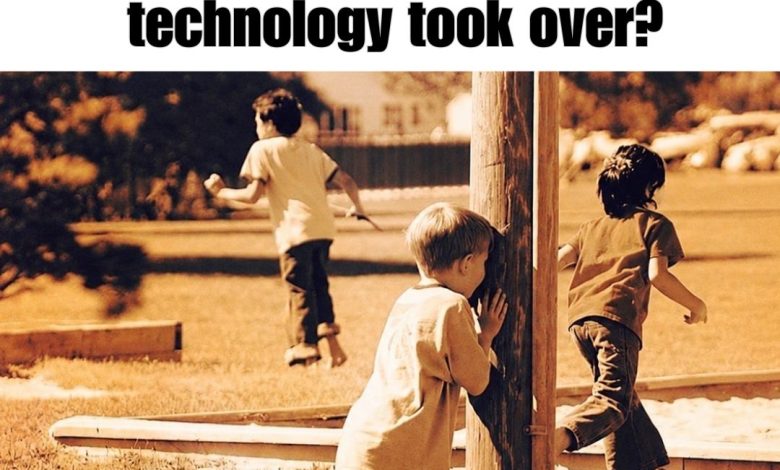
The image asks a simple but powerful question: “Aren’t you thankful your childhood happened before technology took over?” For many Americans, this brings back memories of a time when childhood meant running outside, playing with neighbors, riding bikes, climbing trees, and coming home when the streetlights came on.
This was not a toy or a single invention. It was a style of childhood often called “free-range childhood,” “outdoor play,” “analog childhood,” or “pre-smartphone childhood.”
When did this kind of childhood exist?
Children have always played outdoors, but in the United States, this image especially reminds people of the 1950s through the 1990s. During those decades, many kids spent long hours outside with very little adult supervision. Before smartphones, tablets, social media, and streaming entertainment became common, children often made their own fun.
What was its purpose?
Outdoor play helped children develop imagination, independence, confidence, friendships, and physical strength. Kids invented games, solved arguments face-to-face, explored their neighborhoods, and learned how to handle boredom without a screen.
Common activities included tag, hide-and-seek, kickball, baseball, jump rope, bike riding, tree climbing, building forts, playing in sprinklers, collecting rocks or bugs, and simply hanging out with neighborhood friends.
For many people, this kind of childhood felt slower and more personal. There were no constant notifications, no online pressure, and no need to document every moment. A child’s world was often built around family, school, neighbors, playgrounds, backyards, and imagination.
Still, it is important to be honest: the past was not perfect. Some children were lonely, unsafe, or left out. Technology is not all bad either. Today, it helps kids learn, stay connected with family, access information, and enjoy creative tools. The real issue is not technology itself, but whether it replaces too much real-world play, face-to-face connection, and quiet time.
That is why this image touches so many people. It reminds Americans of a childhood where fun did not require Wi-Fi, batteries, or a screen. It was a time when a simple yard, a few friends, and a long afternoon could become an unforgettable adventure.
In the end, “childhood before technology took over” means a childhood built on outdoor freedom, imagination, neighborhood friendships, and memories made in the real world.