Did anyone ever use a peeler like this one?
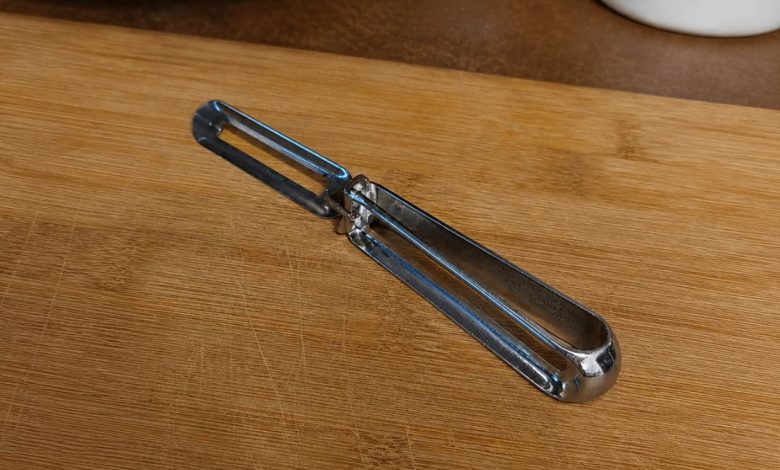
The unusual metal utensil shown in the photograph appears to be an EKCO Slip-Pruf “Nee-Action” potato peeler, or a very similar floating-blade model. These peelers were once common in American kitchens, particularly during the middle decades of the 20th century.
Because no manufacturer’s markings are visible in the photograph, the exact brand cannot be confirmed from appearance alone. However, its all-metal construction, hinged frame and long floating blade closely match the Nee-Action design.
What Was It Called?
The utensil was generally known as a potato peeler, vegetable peeler or floating-blade peeler.
One well-documented version was marketed as the EKCO Slip-Pruf NEE-Action Potato Peeler. The Carnegie Museum of Art attributes that model to American designer Ferdinand E. Fender and dates it to approximately 1940. It was manufactured by the Vaughan Novelty Manufacturing Company, an American company that operated from 1910 until roughly 1984.
The name “Nee-Action” referred to the movement of its cutting mechanism. Unlike a completely rigid blade, the cutter could shift slightly as it moved across the curved surface of a potato or other vegetable.
When Did It First Appear?
The recognizable Nee-Action version dates from around 1940, although vegetable-peeling tools had existed long before that.
Its design was protected by U.S. patents issued during the same period. One associated patent, U.S. Patent No. 2,232,940, covered a potato peeler with sharpened cutting edges on both sides of the blade opening. This allowed the tool to cut while moving in either direction.
These peelers became especially familiar in American households during the 1940s, 1950s and 1960s, when durable stamped-metal kitchen tools were widely produced and often remained in use for decades.
What Was It Used For?
Its primary job was to remove thin outer skins from fruits and vegetables, including:
- Potatoes
- Carrots
- Apples
- Cucumbers
- Pears
The narrow opening in the blade limited how deeply it could cut. One edge removed the peel, while the opposite side helped prevent the blade from slicing too far into the food. This reduced waste compared with peeling with a paring knife.
The floating or flexible blade could follow rounded and uneven surfaces more easily than a fixed cutting edge. Many versions were also sharpened on both sides, making them usable by right-handed or left-handed cooks and allowing peeling strokes in more than one direction.
Why Does It Look So Different From Modern Peelers?
Modern American kitchens commonly use straight swivel peelers with thick plastic or rubber handles. Older models were usually made almost entirely from steel, with a thin open handle and a simple mechanical joint.
The older design had several advantages:
- Strong, durable construction
- No plastic parts to crack
- A blade that followed the shape of the vegetable
- Easy cleaning
- Compact storage
However, the narrow metal handle could become uncomfortable during long peeling jobs, and the exposed metal blade could rust or become dull if it was not dried properly.
A Small Tool That Lasted for Generations
Yes—many people really did use peelers like this one. For families who grew up in America during the mid-20th century, it may bring back memories of preparing potatoes for Sunday dinners, holiday meals or homemade soups.
Although newer ergonomic peelers are often more comfortable, these old metal models were simple, effective and remarkably durable. That is why so many examples still appear today in family kitchen drawers, estate sales and vintage utensil collections.