What is this? My barber rubbed on my skin after shaving me and didn’t know the English name for it.
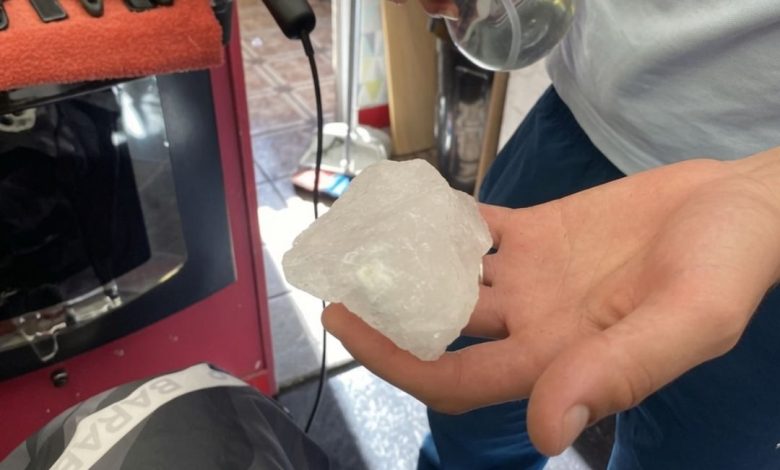
The translucent white stone is most likely an alum block, also called an alum stone, shaving alum, or styptic stone. The simplest name to use in the United States is: “Alum block”
Most shaving blocks are made from potassium alum, whose chemical name is potassium aluminum sulfate. It is a water-soluble mineral salt that forms clear or milky-white crystals. However, the exact chemical composition cannot be confirmed from a photograph alone because some similar blocks contain ammonium alum instead.
When Was Alum Invented?
Alum does not have a single invention date. It is a naturally occurring mineral substance that people learned to collect, purify and crystallize thousands of years ago.
Historical research shows that alum was already being used in ancient Mesopotamia during the first millennium B.C. Surviving texts suggest that some alum-processing methods may have been even older. Ancient societies used it in medicine, leather preparation, textile dyeing and other early chemical processes.
Therefore, the alum block is not a modern shaving invention. It is an ancient material that later became a traditional barbershop product.
Why Do Barbers Rub It on the Skin?
After shaving, the barber wets the stone with water and gently rubs it over the freshly shaved area. Alum acts mainly as an astringent, meaning it temporarily contracts surface tissue.
This produces several useful effects:
It helps control small shaving cuts. Alum has styptic properties, so it can reduce minor bleeding from superficial razor nicks.
It temporarily tightens the skin. The contracting effect can make freshly shaved skin feel firmer.
It may limit bacterial growth. Potassium alum has bacteriostatic properties, meaning it can slow the growth of certain bacteria, although it should not be treated as a complete medical disinfectant.
It can reduce moisture and odor. The same mineral is also used in some crystal deodorants because it limits bacteria associated with body odor.
A mild sting or tightening sensation is common, particularly where the razor irritated the skin.
Is It Safe?
For most people, brief topical use is considered relatively low risk. However, alum can cause dryness, itching, tightness or irritation, especially on sensitive skin or skin with several razor cuts. The residue is generally rinsed away after a short period, followed by a moisturizer or gentle aftershave.
There is also an important hygiene issue: a solid alum stone should ideally not be rubbed directly on multiple customers, particularly when shaving cuts are present. Its antibacterial activity does not make the stone sterile. Some U.S. barbering regulations require bleeding-control products such as powdered alum or sterile liquid astringent to be applied with a disposable, single-use applicator rather than using a shared solid block.